The Nine Tests Published on a Cable Maker's Own Site
KUKA CABLE publishes nine test write-ups for its cable range and a separate numbered list of the top ten tests for PV cables. The nine pages name water resistance, UV accelerated weather testing, abrasion, cold bending, cold elongation, tensile testing after ageing, solderability, static flexibility and construction and dimensional testing. Reading both lists side by side shows a buyer how much of the quality claim is documented at all, and both apply to the solar cables the company sells from 1.5 mm² up to 240 mm².
Key takeaways
- Nine test write-ups are published, covering water, UV, abrasion, cold bending, cold elongation, tensile strength after ageing, solderability, flexibility and dimensions.
- A second list names ten checks for PV cables, organised around a circuit rather than a workshop.
- The 1500 V build is rated DC 1.8/1.8 kV, carries a production spark test and takes 6.5 kV AC for 5 minutes on the finished cable.
- Per-batch pass or fail records, annual capacity and third-party inspection reports are not published.
The nine write-ups, one at a time
- Water resistance covers immersion and moisture exposure, the condition a roof gutter or a leaking flashing creates.
- UV accelerated weathering puts samples under artificial sunlight to see how the compound copes with radiation.
- Abrasion testing rubs the sheath against a hard surface, which is what a cable tray entry does over years.
- Cold bending folds a sample at low temperature, where a stiff compound is most likely to crack.
- Cold elongation stretches the material at that same low temperature and records how far it goes.
- Tensile testing after ageing measures what is left of the original strength once a sample has been weathered.
- Solderability checks whether the metal surface accepts solder, which matters where a conductor is soldered rather than crimped.
- Static flexibility measures how the cable behaves in a fixed bend, the usual state of a dressed DC string.
- Construction and dimensional testing verifies the numbers a datasheet prints: overall diameter, insulation thickness and sheath thickness.
What the ten-item list adds
The second list is arranged around a circuit instead of a workshop. It names conductor resistance, insulation resistance, dielectric strength and connectivity, which together decide whether a cable carries the current and withstands the voltage. It names heat resistance and flame retardancy, which describe behaviour under thermal stress and in a fire. It also names tensile strength, environmental adaptability and corrosion resistance, the last of which matters at every joint, clip and connector on a rooftop.
The overlap between the two lists is partial, and the difference is worth understanding. The test pages describe how the manufacturer stresses and measures its own product. The numbered list describes what any cable has to deliver once it is installed. A specification that only quotes the first is describing a factory; one that only quotes the second is describing a hope.
Where the published values stop
Hard numbers appear for the electrical checks. The 1500 V construction is rated DC 1.8/1.8 kV, is spark tested at 10 kV during production, and takes a test voltage of 6.5 kV AC at 50 Hz for 5 minutes once finished. Its bending radius is given as 4 × the outer diameter, and the standards named alongside it are TUV 2PfG 1169/08.2007, EN 50618:2014 and IEC 62930.
Mechanical tests are described rather than scored. The site explains what each one does and which conditions it simulates, but it does not publish a result for every size, and it does not publish per-batch pass or fail records, an annual capacity figure or third-party inspection reports beyond the certificates it names. That is the honest limit of a test menu: it tells a buyer which questions the laboratory can answer, not what the answer was on a Tuesday in March.
Turning a test menu into an order
The practical use of the menu is as a checklist for the request. The laboratory test page names every check the company runs, and the test list can be quoted directly into a specification, so that the supplier knows which reports are expected. For the PV range the certificate names matter as much as the tests: TUV, IEC, CPR and CE appear across the family, with AD8 waterproofing and CPR fire rating named as regional requirements the company highlights.
Two habits make the checklist work. First, match the test to the failure the site will actually see: cold bending for a winter installation, corrosion resistance for coastal air, UV weathering for a roof with no shade. Second, ask for the report for the exact cross-section and construction on the order, because a result for a 4 mm² sample is not a result for a 10 mm² sample. The nine published pages make both questions easy to ask in writing.
| Published check | What it stresses | Why to request the result |
|---|---|---|
| UV accelerated weathering | compound under artificial sunlight | unshaded rooftop exposure |
| Cold bending | flexibility at low temperature | winter installation and night-time contraction |
| Tensile after ageing | strength left after weathering | clips, ties and cable tray edges |
| Water resistance | immersion and moisture | ponding, gutter leaks and condensation |
| Static flexibility | behaviour in a fixed bend | dressed DC strings at the mounting rail |
| Construction and dimensions | diameter and wall thickness | connector fit and gland sizes |
Worked example
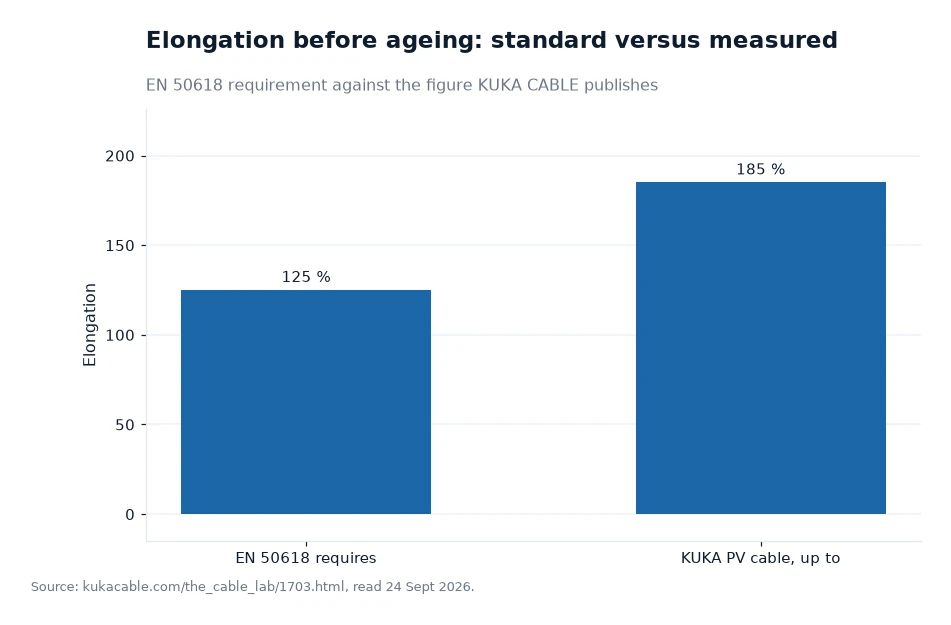
The chart below supplies the ageing figure that sits behind the tensile and elongation checks. Its own title is "Elongation before ageing: standard versus measured", and its two bars are the EN 50618 requirement of 125 and the figure published for the compound of up to 185, taken from kukacable.com/the_cable_lab/1703.html. Two comparisons are my own arithmetic on published numbers: nine test pages against a numbered list of ten leaves a difference of one item, and 185 divided by 125 gives 1.48, so the published elongation sits 48% above the requirement. Neither sum proves anything about a specific reel. They show how much headroom the published figures describe, which is what a specification review is looking for.
Frequently asked questions
Are nine published test pages enough to judge a cable?
They are enough to see what a manufacturer is prepared to document, and not enough to judge a delivery on their own. The pages cover water resistance, UV weathering, abrasion, cold bending, cold elongation, tensile strength after ageing, solderability, static flexibility and dimensional testing. Because per-batch results are not published, the next step is to request the report for the size and construction actually being ordered.
How do the nine test pages differ from the ten-test list?
One documents the laboratory programme and the other describes what a PV circuit demands. The pages are written from the workshop side, explaining how a sample is stressed and measured, while the numbered list names the checks that matter in the field, including conductor resistance, insulation resistance, dielectric strength, heat resistance and corrosion resistance.
What to request alongside a quotation
Send the published list with the enquiry and mark the three checks that match the site conditions. Ask for the ageing report, the dimensional result and the certificate covering the construction on the order, and ask whether the same construction is used for all the sizes in the enquiry. Those questions cost nothing to send and they arrive before the drums are built. If a supplier cannot produce a result for one of the marked checks, that gap is worth knowing about while there is still time to change the specification.
The nine test names are the manufacturer's own index on its website, kukacable.com, inspected 24 Sept 2026[1].